
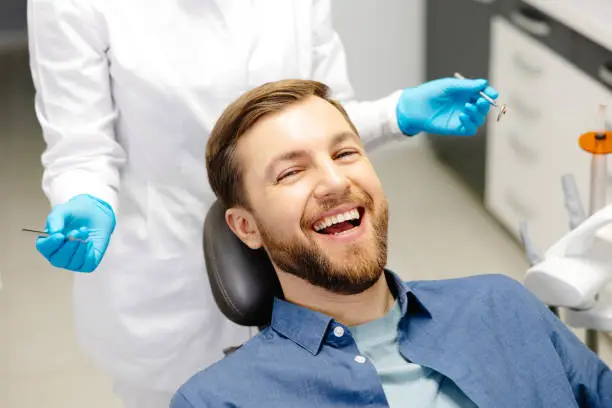
According to the New York Times, “Technology, when misused, poisons air, soil, water, and lives.” Obviously, this saying doesn’t refer to technological advancements in dentistry. With modern innovations, dental services have become more comfortable and personalized. 3D Printing, AI in treatment planning, laser dentistry, and digital scanning are the main topics of our interest today. Explore the advances in dental technology and bring a silver lining to your experience in a dental chair!
1. 3D Printing: Revolutionizing Dental Procedures
Widely used in defense, aerospace, design, and art, 3D technology has substantially transformed the world of dentistry. Advanced technologies and tools increase the accuracy of dental procedures and contribute to a better patient experience.
3D printing working principle:
- A dentist takes a precise digital scan of the patient’s oral cavity or needed dental structure.
- This digital impression is passed on to designated software, enabling the specialist to manipulate it as necessary.
- With the help of specialized dental materials (resins, ceramic composites, etc.), a 3D printer lays down succeeding thin layers until the holistic structure is ready. Layering contributes to each patient’s unique dental anatomy and allows accurate designs and customized fittings.
3D printing is aimed at providing various precise, personalized treatments in a dental clinic:
- bridges;
- crowns,
- drill guides for dental implants;
- dental models for surgery, orthodontics, and prosthodontics.
The first patient received treatment with the help of 3D printing in 1999. Since then, a number of different 3D printing techniques have greatly assisted many dental specialists in diagnostics and treatment planning.
2. AI in Diagnosis and Treatment Planning
Artificial intelligence enables doctors to promptly address urgent dental issues. With the help of AI-powered tools, dentists can analyze patient data and determine whether the case needs instant attention. This ensures utmost accuracy and reduces the risk of potential errors.
AI boasts impressive diagnostic capabilities and proves to be highly useful for planning complex restorative procedures. In addition, the automated measurement of tooth dimensions streamlines digital record-keeping. For dental professionals, staying up to date with these emerging tools often involves enrolling in dental CE courses, which provide the latest insights into AI applications and other modern technologies.
AI algorithms are also indispensable in the development of tailored treatment plans. They analyze numerous factors such as:
- a patient’s genetic profile;
- former health records;
- lifestyle;
- current health conditions.
This substantial analysis ensures the treatment plan perfectly fits an individual patient’s needs.
3. Laser Dentistry: Painless Alternative
Laser dentistry is a godsent for patients with dental anxiety. If you have nightmares about oral surgery or tooth removal, this option can be your lifesaver. Lasers can help you avoid traditional drill-based treatment: patients find it more comfortable and less traumatic.
Laser dentistry efficiently copes with an array of dental problems:
-
- Cavities. Lasers can eliminate decayed tooth parts and prepare your pearly white for filling material. The dentist primarily applies an anesthetic to numb the gums, so the procedure is pain- and blood-free.
- Gum disease. Laser treatment can help reduce plaque and bacteria in your oral cavity, preventing serious health problems such as gum recession and bone loss.
- Pain management. Lasers aid in numbing the treated area and reducing swelling. This method doesn’t need needles or injections to efficiently manage painful conditions.
Based on the required treatment, dentists use hard tissue or soft tissue lasers:
- Soft tissue lasers reduce the need for sutures;
- Hard tissue lasers are best at cutting through tooth structures.
Lasers greatly assist dental professionals during the preparation or shaping of teeth for composite bonding, dental restorations, and decayed tooth structure removal.
4. Digital Scanning and Impressions
Over the last decade, dentists have taken advantage of using intraoral scanners and creating 3D images of scanned objects, which results in highly precise digital impressions of patients’ dental arches.
Digital impressions provide several benefits:
- No need for the casting of physical models;
- No physical storage space is required;
- Heightened patient’s comfort;
- Indispensable for patients with a sensitive gag reflex.
The last point is especially worthy in terms of accuracy as it might be challenging for a doctor to hold the impression tray immovable when a patient is gagging. This affects the mold’s preciseness, making traditional impressions not the best fit for such patients. This uncomfortable experience and distorted result can be easily fixed with digital impressions.
However, digital scanning has one drawback, which is the cost. The high price is explained by the utmost precision the procedure provides for digital dentistry.
Modern Technology for Stress-Free Dental Visits
From routine dental examinations to emergency procedures, from diagnosis to treatment — technologies have set new standards in dental care. Dental treatment has become more precise, faster, and practically painless. To harvest the best of technological advancements in dentistry and get Vip Dental Care, address a modern clinic with highly-trained doctors and updated equipment. You’ll be surprised by the difference between testing 3D printing, laser, and AI-powered tools and your past experience.
